Cutting Walking and ATV Trails Through Woods and Heavy Brush
A good trail is planned on foot before any machine moves. Here's how to lay one out for walking, ATVs or hunting access.
October 16, 2026 · 4 min read
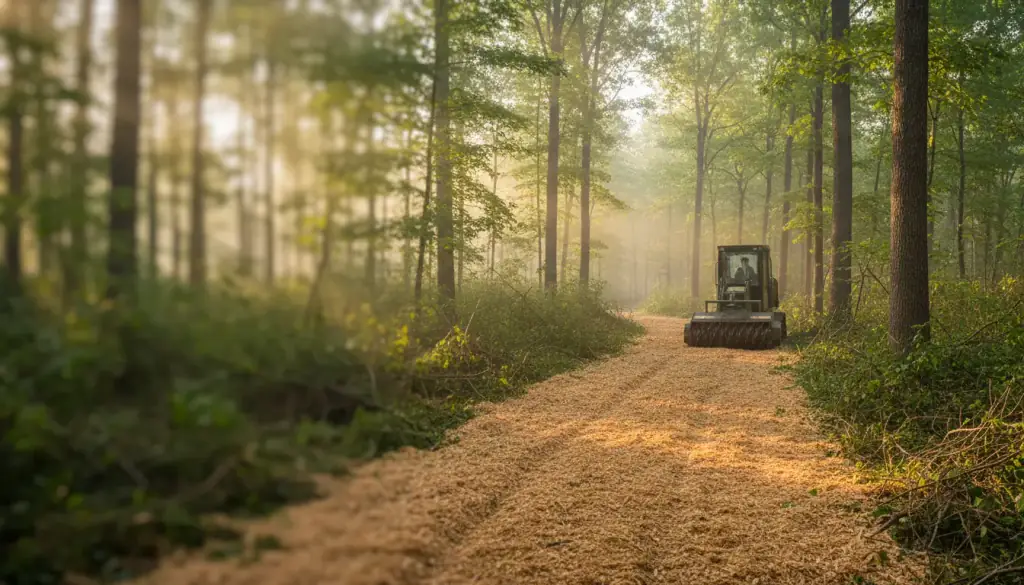
A trail changes how you use your land. Suddenly the back forty is somewhere you can walk on a Sunday afternoon, haul a stand to before deer season, or ride an ATV to without fighting the briars the whole way. But a trail cut carelessly through woods and heavy brush can turn into a muddy ditch, a drainage problem or a path nobody wants to use.
Whether you want a quiet walking path, a hunting access route or something an ATV can run all day, a little planning goes a long way.
Walk it before you cut it
Start on foot. Walk the route you have in mind and see what the land is actually doing. Where does water run when it rains? Where is the ground soft? Where do the big trees stand, and which ones would you hate to lose? A route that looks perfect on a satellite photo can run straight into a seep, a rock outcrop or a gully that doesn't show from above.
Flag the route with tape as you go. Then walk it again from the other direction, because a trail looks different coming back. It's much easier to move a strip of tape than to move a finished trail.
The best trails follow the land rather than fight it. On a slope, running a trail straight up and down the hill gives water a perfect channel, and it will cut a rut faster than you'd believe. Trails that angle across the slope, or switch back gently, hold up far better. Where the trail has to cross a low spot or a drainage, pick the narrowest, firmest crossing you can find, and avoid running along the bottom of a wet draw.
Loops are worth thinking about. A trail that dead ends at a hunting stand works fine, but a loop lets you move through the property without backtracking, and it spreads out wear. If you can tie a trail into an existing gate, fence opening or farm road, access gets easier for everyone.
How wide should it be?
That depends entirely on what's going to use it. A walking trail can be quite narrow, just enough that you aren't brushing against briars with every step. A trail for ATVs needs to be noticeably wider than the machine itself, with room for the rider's elbows and enough overhead clearance that low limbs don't catch a helmet. A hunting access path often wants to be as quiet and inconspicuous as possible, so narrower with a light touch is usually better.
Corners matter too. Tight turns that look fine on foot can be miserable on four wheels. Easing the bends makes a trail more usable and spares the ground from being torn up by riders fighting a sharp corner.
Protecting trees, roots and soil
A trail is not a reason to clear a wide swath of woods. With selective clearing, the operator cuts the understory, brush and honeysuckle out of the path and leaves the mature trees standing, bending the route around the ones you care about instead of straight through them. That keeps the canopy, the shade and the character of the woods intact.
Surface matters as well. Ground that's been cleared of brush and covered with a layer of wood chips from mulching tends to be easier on feet and tires, and it helps keep bare soil from washing out. Stumps and root flares are the other thing to think about. Cutting them low and leaving them is usually fine for walking, but a trail that ATVs will run needs the stumps cut low enough to roll over safely.
Before the work starts, it helps to know:
- What will use the trail: walkers, ATVs, a side by side, or hunters only.
- Where it needs to start, end and connect.
- Which trees and landmarks the route should avoid.
- Where water collects after a hard rain.
Keeping a trail usable
Cutting the trail is only half the job. Brush and vines grow back into any opening, and a trail that gets no attention gets narrower each season. A quick pass to cut back encroaching growth keeps it open far more easily than waiting until you can't get through. Watch for low spots that hold water or places where the soil is starting to wash, and deal with them early before they turn into a real problem.
If you're working with a crew, a quick walk of the finished route together is worth the time. It's the best way to make sure the trail you pictured and the trail you got are the same trail.
Cutting walking or ATV trails and clearing hunting access paths is the heart of our Standard Land Clearing & Trail Work tier, built for moderate overgrowth and selective clearing with the natural character of your property kept intact. Volunteer Land & Brush is locally veteran-owned and serves Middle Tennessee. Call (615) 478-7628, tell us where you want to go and what will be riding on it, and we'll plan the route around your land.
Volunteer Land & Brush LLC, (615) 478-7628
Call (615) 478-7628More articles
How to Get Rid of Honeysuckle on Your Property
Honeysuckle is beatable, but not in a single pass. Here's how it spreads and how to clear it while keeping the trees you care about.
How to Clear Overgrown Land Without Damaging the Trees You Want
The goal isn't a bare lot. It's usable land with the shade trees, hardwoods and fence-line giants still standing.